











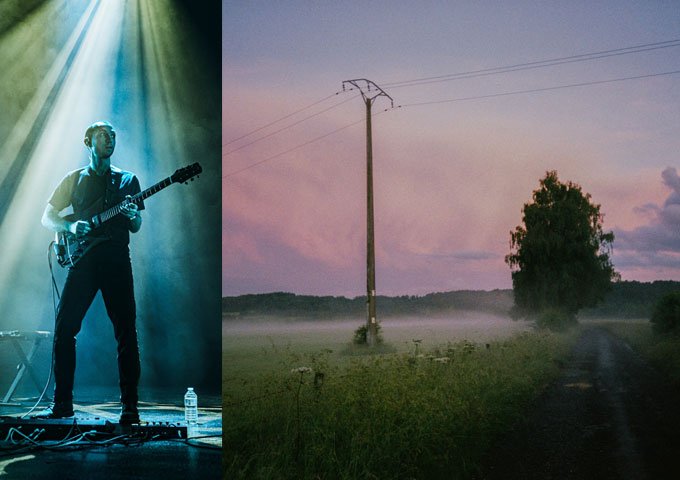
Some musicians spend their careers mastering one language. Roeland Celis has spent his learning several, and on his new EP “The Human Element” – officially releasing April 24 2026 – he finally speaks them all at once. The Brussels-based guitarist and composer has long operated across a broad musical spectrum, but this four-track release represents something altogether more focused and, frankly, more thrilling than anything in his catalogue to date.
Celis grew up in a household where music was a first language. With both parents classically trained, the young Roeland was enrolled at his local music academy by the age of eight, where a fascination with the electric guitar and its wilder possibilities quietly took root. By eighteen, he was studying jazz at the Lemmensinstituut in Leuven, a path that eventually led him to the Conservatorium van Amsterdam and then the Conservatory of Antwerp, where he earned his master’s degree. In 2016, a BAEF scholarship took him to New York City and the Aaron Copland School of Music, a defining chapter in his artistic development and one that clearly sharpened the sense of daring that runs through every bar of this EP.
But before the jazz conservatories and the transatlantic scholarships, there was a teenager transfixed by guitar heroes. Jimi Hendrix’s volcanic expressionism, the raw physicality of early heavy metal, the theatrical excess of the 1980s shred era, grunge, alternative metal, math rock, post-rock, all of it poured into the foundation of how Celis hears and plays the instrument. Jazz arrived later and opened a different kind of door, one that led to improvisation not merely as a soloist’s indulgence but as a collective conversation, a living, breathing exchange between musicians in real time. The merger of personal identity and spontaneous musicality was, as Celis himself has described it, like magic.
What makes “The Human Element” conceptually compelling is the tension it holds between these two worlds. Progressive metal, particularly in its modern form, is an architecture of precision. Arrangements are elaborate, tempos shift with mathematical intent, and the level of production and technical musicianship the genre now demands is genuinely staggering. And yet Roeland Celis wanted to carry into that world something fundamentally at odds with total control: the jazz musician’s refusal to play the same solo twice. The EP’s very title articulates this philosophy. The human element is the organic, spontaneous, irreproducible quality that no algorithm, no quantised grid, no perfectly recalled notation can replicate. It is the variable that makes music feel alive rather than assembled.
The EP opens with “The Common Thread”, a seven-minute statement of intent that wastes no time establishing its emotional range. It begins with clean, cinematic guitar shimmers and atmospheric vocal harmonies that create a sense of suspended anticipation before the song detonates into overdriven riffs, thundering drums, and an accelerating momentum that refuses to plateau. What follows is a kinetic tour through shifting tempos and moods, laced with devastatingly fast shredding and sweeping progressive arrangements that edge toward the euphoric. It is the kind of track that demands repeated listening simply to catch everything happening within it, and it closes with the same shimmering quiet with which it began, as though the storm has passed and something has changed.
“Seismic Shift”, the second track, earns its title fully. The rhythm section here is unrelenting, a chugging, thunderous pulse over which Celis launches solos of real explosive force. There is a directness to the track that provides strong contrast to the more cinematic ambitions of the opener. If “The Common Thread” is a journey, “Seismic Shift” is an impact, a song that hits hard and keeps its grip throughout.
The third track, “Mistbank”, is the EP’s most striking detour and arguably its most emotionally eloquent moment. Setting aside the guitar pyrotechnics almost entirely, Roeland Celis builds the soundscape around complex choral vocal arrangements that carry an ethereal, melancholic, and deeply spiritual weight. The effect is surprising and genuinely moving. It speaks to an artistic confidence to strip away the technical showmanship and let atmosphere and texture carry the emotional burden. The choral contributions from Ella Hintjens, Muriel Urquidi, Harmen Goossens, and Jonas Veirman are extraordinary here, lending the track a humanity that reinforces the EP’s central theme in the most direct possible way.
The closing track, “Panorama”, snaps the listener back with muted guitar arpeggios and laser-sharp lead lines that quickly build into another colossal seven-minute construction. There is a vibrancy and a restlessness to it, a refusal to settle into any one shape for too long, as progressive shifts and dynamic swells keep pushing the arrangement into new territory. The invigorating tension holds right until the final stretch, when the choral harmonies return to bring the EP to a gradual, graceful conclusion. It is a deeply satisfying close, and the symmetry with “Mistbank” gives the overall EP a structural elegance that elevates it beyond a simple collection of tracks.
Throughout all four songs, the rhythm section of Hendrik Vanattenhoven on bass and Siebe Hermans on drums provides the kind of locked-in, responsive foundation that allows Celis to take creative risks without the music losing its footing. Their contribution is considerable. The sonic architecture built by mix and production engineer Chiaran Verheyden and mastering engineer Simon Grove ensures that the EP sounds enormous without sacrificing the warmth and nuance that the more intimate passages require, while Grégoire Verbeke’s cover art provides an intriguing visual correlate to the music’s ambitions.
“The Human Element” is, in the best sense, an act of nerve. It is a guitarist of serious jazz pedigree stepping into a genre that demands a different kind of physicality, bringing with him not just his formidable technique but a philosophy about music-making that genuinely enriches the result. Roeland Celis has made a guitar-driven record that thinks as well as it hits, and that combination is rarer than it should be.
In closing, and as a note of interest, the Bandcamp platform currently promises a fifth track to be present on the EP, namely “Horror Vacui,” so be prepared for Roeland Celis to possibly unleash an extra dose of guitar magic on “The Human Element.”



No Comment